PIAZZA SAN MARCO
MUSEUMS CARD
Doge's Palace, Correr Museum, National Archaeological Museum, Monumental Rooms of the Marcian Library and Clock Tower
VERSIONE ITALIANA
DOGE'S PALACE
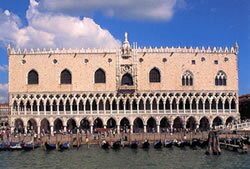 Masterpiece of the gothic art, Palazzo Ducale is an impressive structure of layers of constructive and ornamental elements: from its ancient bases from the 1300's to the renaissance additions and the splendid manneristic signs. Masterpiece of the gothic art, Palazzo Ducale is an impressive structure of layers of constructive and ornamental elements: from its ancient bases from the 1300's to the renaissance additions and the splendid manneristic signs.
It is formed by three big parts that had put together the old constructions: the wind that to the South is the oldest and contains the Sala del Maggior Consiglio; the wing that faces the Square, ex Palazzo di Giustizia, contains the Sala dello Scrutinio; and the Renaissance wing hosts the Doge's residence and many government offices.
In the ground floor is hosted the Museo dell'Opera; the first floor, called Piano delle Logge, hosts the offices of Sorpintendenza per i Beni Ambientali e Architettonici di Venezia and some offices of the direction of the Musei Civici Veneziani, as well as the apartments of the Doge. Between the Piano delle Logge and the second floor, are located the Stanze Istituzionali, where the politic and administrative life of the Republic was conducted. Here are hosted the rooms of the main government components: the Maggior Consiglio, the Senato, the Collegio, and the most important justice magistratures, from the Consiglio dei Dieci to the Quarantie
The visit continues with the two lower floors and the prisons courtyard, where a trail has been set up showing a ceramic collection from the archaeological excavations of the zone. This trail is then linked to the Ponte dei Sospiri and the Sala dei Censori. The last part of the visit is the Armeria, today a precious museum of arms and ammunitions.
CORRER MUSEUM
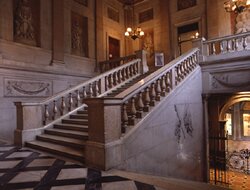 The Correr Museum takes its name from Teodoro Correr, noble of an ancient venetian family, that donated his art collection to the city, together with Palazzo in San Zan Degolà, where it was kept, and to further resources to preserve and increase the collection, the main nucleus of the Civic Museums of Venice. The collection is hosted in Piazza San Marco, in the spaces of the Ala Napoleonica and part of the Procuraterie Nuove. The Correr Museum takes its name from Teodoro Correr, noble of an ancient venetian family, that donated his art collection to the city, together with Palazzo in San Zan Degolà, where it was kept, and to further resources to preserve and increase the collection, the main nucleus of the Civic Museums of Venice. The collection is hosted in Piazza San Marco, in the spaces of the Ala Napoleonica and part of the Procuraterie Nuove.
The Museum proposes several itineraries to discovery of Venice art and history: the first visits the Ala Napoleonica in the splendid Neoclassic rooms; the second, through the Procuraterie Nuove, illustrates several aspects of venetian civilization; and the third includes ancient art exhibitions.
NATIONAL ARCHAEOLOGICAL MUSEUM
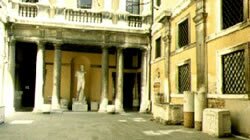 Museum is housed in some environments of the Sansoviniana Library and of the New Procuraties and keep an important collection of Greek sculptures, fragments of architectures, sculptures, busts, epigraphs and a numismatics collection (from the third to the first century B.C.). Museum is housed in some environments of the Sansoviniana Library and of the New Procuraties and keep an important collection of Greek sculptures, fragments of architectures, sculptures, busts, epigraphs and a numismatics collection (from the third to the first century B.C.).
The Museum was born from the legacy that the Cardinal Domenico Grimani gave to the Republic of Venice in 1522, including some precious statues of the fifth and fourth century B.C., the busts of Traiano and Vitellio, and some examples of paleochristian art.
The Archaeological Museum of Venice keeps an important collection of Greek and Roman sculptures, including several original Greeks of the classic period, which sometimes conferred importance to the collections of the venetian noble families, active in the antique dealer market of the colonies.
MONUMENTAL ROOMS OF THE MARCIAN LIBRARY
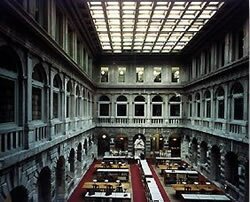 The Marcian Library (that is, San Mark's, Venice saint patron, library) initiated its collection in 1468 when Cardinal Bessarione donated his collection of 750 codes. In 1537 Jacopo Sansovino designed the building to keep the library collection, mixing the Renassaince and the Venetian styles. The Marcian Library (that is, San Mark's, Venice saint patron, library) initiated its collection in 1468 when Cardinal Bessarione donated his collection of 750 codes. In 1537 Jacopo Sansovino designed the building to keep the library collection, mixing the Renassaince and the Venetian styles.
The Hall, originally created for the University, was transformed in 1591 to 1595 by Vicenzo Scamozzi to host the Museo Statuario della Repubblica, with more than 200 marbles of the Grimani's and Contarini's collections, donated to Venice by the end of the 16th Century.
La Marcian Library has now almost 1 milion volumes, including 13000 manuscripts, and a rich colletion of books about greek culture and Venice history.
CLOCK TOWER
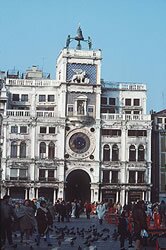 It is placed to east side of the Old Procuraties, just to the entrance for the Haberdasheries. It is placed to east side of the Old Procuraties, just to the entrance for the Haberdasheries.
The Tower was built on a project of Mauro Codussi between 1496 and 1499; in 1755 it suffered an intervention of George Massari who consolidated its structure.
The hours are beated by the sound of the two bronze Moors (1497) that beat with their hammers the enormous bell. The quadrant of the clock points out, besides the hours, the lunar phases and the motion of the sun in the Zodiac.
The base of the tower is the entrance to the ancient Mercerie, which is the principal retail street.
Cost:
Full price: € 13.98
Reduced price: € 8.48
Special reduced price: € 5.98
Free entrance: € 1.98
Choose your cards and add them to your basket!
 |
REDUCTIONS IN CARDS PRICE:
- Reduced price cards:
- children from 6 to 14 years old
- persons guiding groups of children and schools (maximum two for group)
- students from 15 to 29 years old
- European Union citizens over 65 years old
- members of the Ministero dei Beni Culturali
- owners of Carta Rolling Venice
- Free cards:
- Venice residents
- children from 0 to 5 years old
- disabled persons with company
- authorized guides
- tourist translaters
- group leaders (minimum 21 persons)
- ICOM
- Cards Validity:
- Cards must be picked up at museum indicated in the confirmation voucher at indicated date and time. Cards are valid for use three months after pick up date, for visiting museums included.
Please notice you'll be asked to exhibit an identity document at the museum entrance
|
|