The age long exhibition problems concerning the 17th and 18th Century art, once a prevailing concern for the Gallery. Only a minimal selection exhibited since World War II.
The preparation of the exhibition project for the recently reopened Caravaggio, Rembrandt and 18th C. rooms, of which I have had the primary responsibility as Director of said department, has reproposed more urgently the problems that have concerned the Uffizi' 17th and 18th Century collections: the area available for their exhibition has been noticeably reduced in a progressive fashion since the post-war era. Although it is sufficient to bare in mind the museums age old exhibition problems in order to understand that these works have always been represented, sometimes even in a predominant fashion with respect to the Renaissance and "Primitive" era.
In the very same Tribune, area originally destined to house the very best of the collection and which now houses the important 16th Century works, they have been alternately exchanged over time works believed (and today still partially recognised signatures) to be of, among others, Albani, Caravaggio, Carracci, Domenichino, Dou, Guercino, Lanfranco, Pourbus, Reni, Rubens, Van Dyck. They were truly works of the 17th Century (Rubens, Sustermans) which graced the new rooms of Niobe, a prime example of Lorraine architecture; whilst at the same time in the Gallery's corridors, turned into picture galleries (moreover rather varied) important and qualified 17th and 18th C. works were exhibited.
The reorganisation of the museum following the Napoleonic upheaval and the general storage reconnaissance during the 19th Century witnesses the progressive strengthening with new found historical acclaim, other than the prestigious works of the older eras, of the presence of paintings belonging to the era in question (Snyders, Honthorst, Seghers, Batoni, Fabre) according to the even more extensive documentary criteria, following the transition to the Italian monarchy, the Gallery was destined to house purely antique paintings and sculptures.
Thus it is not surprising that at the beginning of the 20th Century, possibly the peak for listings of works in the museum (note the Pieraccini catalogue, 1910), one finds almost exclusively 17th and 18th Century paintings adorning the 2nd and 3rd corridor walls, and also in the rooms dedicated to watercolours and miniatures, and those of Giovanni da San Giovanni, Baroccio, Rubens. The Vasari Corridor exhibited 328 portraits of the "iconographic" collection, almost all dating to the 17th and 18th C., periods in which, up until 1926 (Poggi catalogue), were reserved practically eight rooms.
Following World War II, the situation was notably different with the new clear ordering of Roberto Salvini in strict chronological order sub-dived by schools which, asides from the massive thinning out of works, favoured Italian 14th C. and Renaissance artworks: naturally, also a consequence of the studies and rediscoveries in that sector which had distinguished the previous decades.
But in that particular moment in history, the Uffizi Gallery appears less hospitable to those periods that research and taste had not brought to the lime-light: concentrated in the final part of the Gallery, from halfway down the 3rd Corridor, the works post 16th C. were, in comparison to the past, indeed reduced to little more than a sampling, destined to be further diminished when, in 1971 the reopening of the exit staircase forced numerous rooms, which were positioned in the present entrance-hall, to be dismantled. The Venetian and French 18th C. works thus ended up on axles in between statues in the Niobe room, up until 1981, when they were reunified in the last room of the museum next to the other two room dedicated to Caravaggio and Rembrandt: these three rooms are today, as they were then, the only rooms in the Gallery dedicated to the 17th and 18th C. paintings.
However, one should add that during the 60's, the director at that time, Luciano Berti partially rectified this situation, laying the basis for an inspection, if not for a rescue, of that which had once been exhibited in the museum: this was in fact the criteria behind the complying of the 1979 Uffizi's General Catalogue of which the paintings belonging to the eras in question constitute the principal part.
Furthermore, in 1973 the restoration and reopening of the Vasari Corridor had allowed, albeit not always in optimum viewing conditions, the exhibition of large sections of historical collections: in particular the works of the 17th and 18th C. exhibited in the two rooms at the foot of the staircase and parallel to Lungarno Archibusieri, progressed as a natural continuation, in chronological order, to that which one can view in the Gallery. One should not forget that meantime the research and exhibitions on general 17th C. painting, and in particular on those present in the Florentine collection, had given fame and glory back to the artistic productions of those long disregarded eras.
Coming back to the present day, it has already been mentioned the difficulties in selecting from storage or from the Vasari Corridor, the works to be displayed in the preparation of the last rooms of the museum, difficulties that derive from the embarrassingly vast choice available between works that have long passed the close screening of critics, already restored and, both for their excellent quality along with their historical importance, deserving of display in the standard circuits of the Gallery. As evidence of the existence and great value of this "hidden museum", a sampling of works will be provisionally exhibited in some rooms on the second floor, but it is in the New Uffizi that an availability of display spaces should necessarily emerge that could house the precious core collections of the Medici and Lorena families, out of respect for the long and complex museological happenings that, exhibiting the best of each era, has always witnessed a Gallery that produces culture and prestige (but also handsome profits) per the city that hosts it.
|
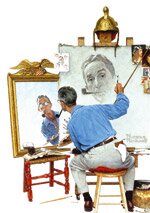 The exhibition opened on September 17th 2004 at Uffizi Gallery, offers the visitor a wide and elastic view of the production of international artists that, during the 20th Century, have marked all the various artistic expressions, leaving their own mark in their studies, through their self portraits, of problems that link history and sociology, the psychological researches and anxiety and questions that have crossed the century.