|
We invite you to join us in a marvelous trip to San Gimignano. Our itinerary includes: Piazza della Cisterna, Duomo, Podestà palace and Sant'Agostino Church. TOUR HIGHLIGHTS
- Throughout the tour, you will be guided by an expert in History or Art history, who will help you to discover Tuscany. You can choose the language you prefer...we have 14 different languages available!
- You can choose the departure point: you can meet you guide in a fixed point or, if you prefer, he can pick you up in your hotel!
- If you are a small party, then this is the tour for you...you own guide all over Tuscany!
- Admission to museums indicated is included.
-
Prices without car: (for group)
- 1 up to 10 persons : € 200
- 11 up to 20 persons : € 170
- over 20 persons : € 170 + € 2,75 for each added person
-
Prices with car: (for group)
- 1 up to 3 persons : € 200 + € 270
- 4 up to 8 persons : € 200 + € 300
- 9 up to 16 persons : € 200 (up to 10 persons) or € 170 (from 11 to 16 persons) + € 410
- 17 up to 24 persons : € 160 (up to 20 persons) + € 2,75 for each added person + € 450
- 25 up to 35 persons : € 160 (up to 20 persons) + € 2,75 for each added person + € 480
- 36 up to 54 : € 160 (up to 20 persons) + € 2,75 for each added person + € 540
ITINERARY
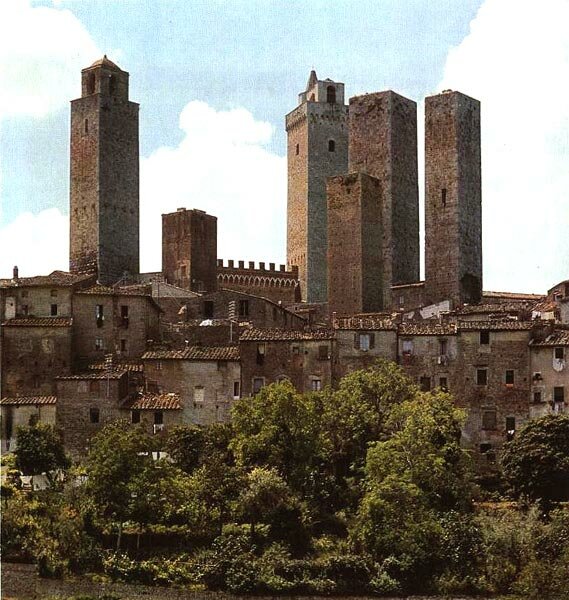
San Gimignano rises on a hill (334m high) dominating the Elsa Valley with its towers. Once the seat of a small Etruscan village of the Hellenistic period (200-300 BC) it began its life as a town in the 10th century taking its name from the Holy Bishop of Modena, St. Gimignano, who is said to have saved the village from the barbarian hordes.
The town increased in wealth and developed greatly during the Middle Ages thanks to the "Via Francigena" the trading and pilgrim's route that crossed it. Such prosperity lead to the flourishing of works of art to adorn the churches and monasteries. In 1199 it became a free municipality and fought against the Bishops of Volterra and the surrounding municipalities. Due to internal power struggles it eventually divided into two factions one headed by the Ardinghelli family (Guelphs) and the other by the Salvucci family (Ghibellines).
On the 8th May 1300 Dante Alighieri came to San Gimignano as the Ambassador of the Guelph League in Tuscany. In 1348 San Gimignano's population was drastically reduced by the Black Death Plague throwing the city into a serious crisis which eventually led to its submission to Florence in 1353. In the following centuries San Gimignano overcame its decline and isolation when its beauty and cultural importance together with its agricultural heritage were rediscovered. The construction of the towers dates back to the 11th and 13th centuries. The architecture of the city was influenced by Pisa, Siena and Florence. There are 14th century paintings of the Sienese School to be seen and 15th century paintings of the Florentine School.
|


